

Value creation and operational improvement
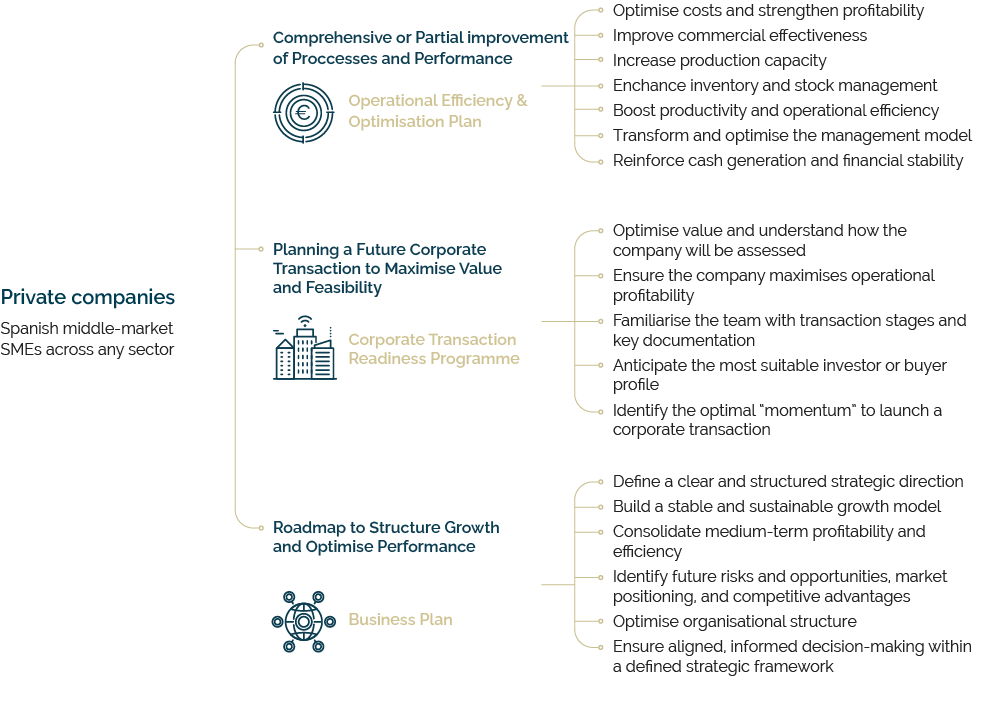
Optimization and operational efficiency plans (Marketing & Sales, Industrial Operations, Organizational Model)
We transform business operations into tangible value through our OBR methodology (Operational Business Review – The agile method to unlock your value), identifying and implementing with the teams improvement levers that optimize profitability, efficiency and cash generation with a direct and sustainable impact on EBITDA and working capital.
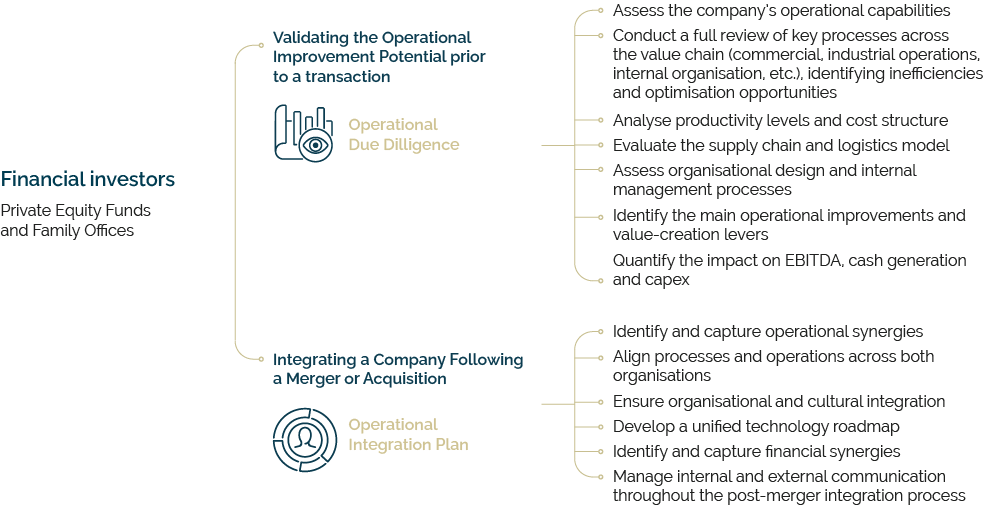
Operational Due Diligence
We conduct rigorous, independent, and value-capturing operational due diligence, validating the real potential of the asset through the analysis of operational levers with a direct impact on EBITDA and cash flow.
Preparing the company for a potential sale
We guide our clients through the comprehensive preparation of a potential sales process, covering all its stages: from understanding the transactional logic to analyzing key information and risks, ensuring the business is ready for a future transaction. Throughout the process, we identify and implement operational improvements using our OBR methodology, strengthening market positioning and increasing the potential value of the transaction.
Company integration plans
We design and implement operational integration plans for companies, identifying and capturing operational synergies (using our OBR methodology), aligning processes and organizational structures, with the aim of ensuring operational and cultural integration, planning technological unification and post-operation communication, ensuring an efficient transition and generating maximum long-term value.
Operational business plans
We develop and implement Operational Business Plans that optimize efficiency, through our OBR (Operational Business Review – The agile method to unlock your value) methodology, drive growth and maximize the long-term value of companies, ensuring the future competitiveness of our clients.
Main magnitudes
Customer typology and their motivations
Main objectives to be achieved
Understanding the business model and its key levers
Analyze the factors that drive profitability and growth, identifying the differentiating elements that add value. Understand how the company is structured within its sector and what competitive advantages it can leverage.
To ensure that the company operates with maximum efficiency.
Identify inefficiencies in operational and financial processes to optimize resource use. Implement improvements that reduce costs, improve productivity, and increase profitability without compromising quality or service.
Increase the value of the company
Increase the overall value of the company by implementing operational improvements that enhance EBITDA and cash flow generation. Generate additional sustainable value by optimizing processes, improving people, and creating more reliable and accurate information systems for decision-making.
Optimize the use of working capital
Possibility of offering a variety of financing alternatives, both banking and non-banking, to fulfill the business plan.
Having clear and accurate information
Ensure that data accurately and analytically reflects the reality of the business. Improve control and reporting systems so that decision-making is based on reliable, real-time information.
Ensure a solid organizational structure
Ensure a solid organizational structure
Strengthen and align the management team with the objectives
Evaluate the management team's competencies, offering specific training to improve strategic decision-making and ensure that all team members work towards the same improvement objectives, strengthening relationships, the culture of continuous improvement, and their leadership.
Visibility during the process
We work under a monthly monitoring system that provides the client with an up-to-date and clear view of the progress of their company's transformation and the value generated through implementation. In this way, we guarantee control over the status of the implemented actions, allowing us to adjust for deviations and ensure sustainable results.
Preparing the company for future scenarios
To lay the groundwork for the company to successfully address key medium- and long-term decisions, such as expansion, diversification, or seeking investors. To design a flexible structure that allows for rapid and robust adaptation to market changes.
Typical phases of an Operating Value process
- Comprehensive company evaluation through analysis of its processes and metrics, organizational and management model, methodologies, technological maturity level, and human resources.
- In-depth review of Marketing & Sales, Supply Chain, Manufacturing, Organizational Model, Operational Finance, and ESG policies, using a proven methodology.
- Final report with opportunities for cost reduction and efficiency improvements, and their impacts on EBITDA and Cash Flow.
Support during implementation
- Generation of the necessary roadmap to put the identified opportunities into action.
- Continuous monitoring of the work plan and daily support for its implementation and integration.
- Work plans by area.
- Implementation of management tools.
- Follow-up and monitoring meetings to assess the impacts generated:
- Control of deviations and necessary adjustments.
- PMO planning and methodology for monitoring and adaptation.
- Monthly monitoring report.
- Dashboard of potential savings vs. achievement.
Review and preparation of information
- In-depth analysis of necessary analyses that, due to complexity, poor data quality, or lack thereof, could not be performed during the diagnostic phase.
- Tailored training for the teams in each functional area, according to their needs.
- Support in incorporating or creating the necessary tools for capturing non-existent data.
- Training sessions.
- Final support stage to ensure the sustainability of the implemented actions and improvements.
- Materialization of impacts: value creation.
- Ongoing support for the day-to-day change management process for internal transformation.
- Final report on impacts and implemented improvements.
OBR Methodology. Operational Business Review
The agile method to unlock your value
with Agility
with Precision
We transform the diagnosis into a precise and prioritized action plan, enabling quick and focused decisions to maximize company results.
Quickly
We support and train teams throughout the implementation process, from day one, accelerating the generation of real value and ensuring tangible results from the earliest stages.
Value
We measure, adjust, and consolidate the implemented improvements to capture the operational value created and ensure that the impact is scalable in the long term.
Contact us to schedule an introductory meeting
Basic information on Data Protection
Responsible: IMPLICA CORPORATE FINANCE SL Purpose: 1. To attend, answer and manage the consultations or requests received; 2. To manage the sending of the IMPLICA CORPORATE FINANCE SL newsletter or bulletin. Rights: You can exercise your rights of access, rectification, deletion, opposition, limitation and portability if applicable to e-mail: info@implicacf.com. You have the right to withdraw your consent at any time. More information: https://implicacf.com/en/privacy-policy/