

Financing and debt
Corporate finance
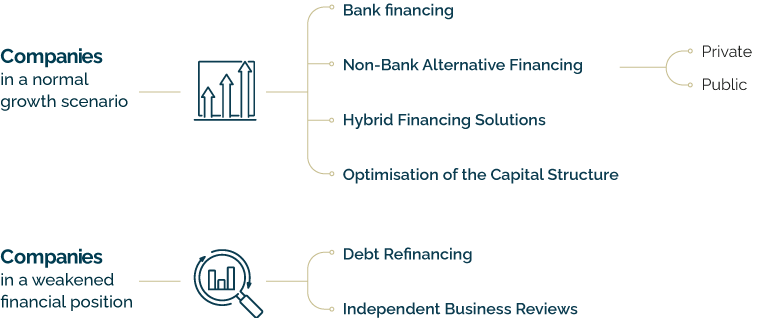
New financing for CAPEX and/or working capital tailored to the needs of companies’ business plans. Depending on the number of participating financing entities, the financing will be bilateral (a single entity) or syndicated/framework agreement (more than one entity). Bank and alternative financing options available.
Structured finance
A financing method typically used for leveraged buyouts, financing projects that require high levels of leverage (energy, infrastructure, real estate) where recourse to the sponsor is not usually available.
Optimization of the financial structure
Restructuring of existing debt and new financing to support the business plan and/or improve terms (deadlines, limits, guarantees, and guarantors). Bank and alternative financing.
Refinancings
Processes in which the company does not generate sufficient cash to meet its existing financial obligations and it becomes necessary to refinance its debt with current lenders. Bank and Alternative Financing.
Equity and Debt mix
Simultaneous search for equity investors and financing to meet the needs of the business plan. Bank and alternative financing options.
Independent Business Review (IBRs)
Independent Business Plan Review Work for financial entities, commonly used in refinancing processes where financial entities need reassurance from an independent third party regarding the viability of the business plan submitted by the company to be refinanced.
Main magnitudes
Transactions advised in recent years
Types of operations
Customer typology and their motivations
Why hire a Debt Advisory?
Visibility and Transparency
We streamline the process of gaining visibility into key metrics. We bring transparency to the debt and/or investor search process.
Credibility
To lend credibility to the business plan and the study of the company's cash flow generation.
Negotiation and Coordination
Experience in negotiation and strengthening skills in meetings with financial institutions and potential funders.
Financing Alternatives
Possibility of offering a variety of financing alternatives, both banking and non-banking, to fulfill the business plan.
Not losing focus on the business.
Allowing the client to dedicate most of their time to the business. These types of operations are very time-consuming, a significant percentage of which is assumed by the Debt advisor, freeing up the company's managers and owners.
Providing security to the customer
To channel the client's concerns regarding any aspect related to the potential transaction.
Gaining the trust of the counterparty
Maintaining a good relationship and empathy with the different counterparties (taking care of all the details and avoiding confrontations) throughout the entire process, with an operational focus.
Typical phases of the Debt Advisory process
Operation Analysis
- Preparation of projections with sufficient timeframes to accommodate the amortization periods of future debt.
- Preparation of a high-level business plan for the company.
- Analysis of current debt, differentiating between short-term and long-term, ordinary and preferred, financial and commercial debt, etc.
- Analysis of the collateral that will support the debt.
Simulations
- Analysis of the need to optimize existing bilateral debt.
- Using the debt projections and analysis, different scenarios will be simulated to determine the optimal amount and type of debt.
Funding Proposal
- Once the best option has been simulated, the business plan to be proposed to the financing entities will be presented in a complete financial plan report.
- Defining the negotiation strategy and tactics with potential funders.
- Meetings with potential funders, monitoring internal approval committees, minimizing approval delays, and fostering a competitive spirit.
- Analyzing received approvals (structure and financial terms) and, if necessary, unifying criteria under a consensus Term Sheet to maximize the highest possible subscription rate.
- Analyzing and monitoring the Debt agreement from a financial perspective and providing support to the legal department.
- Managing the information to be delivered to funders before, during, and after the transaction.